

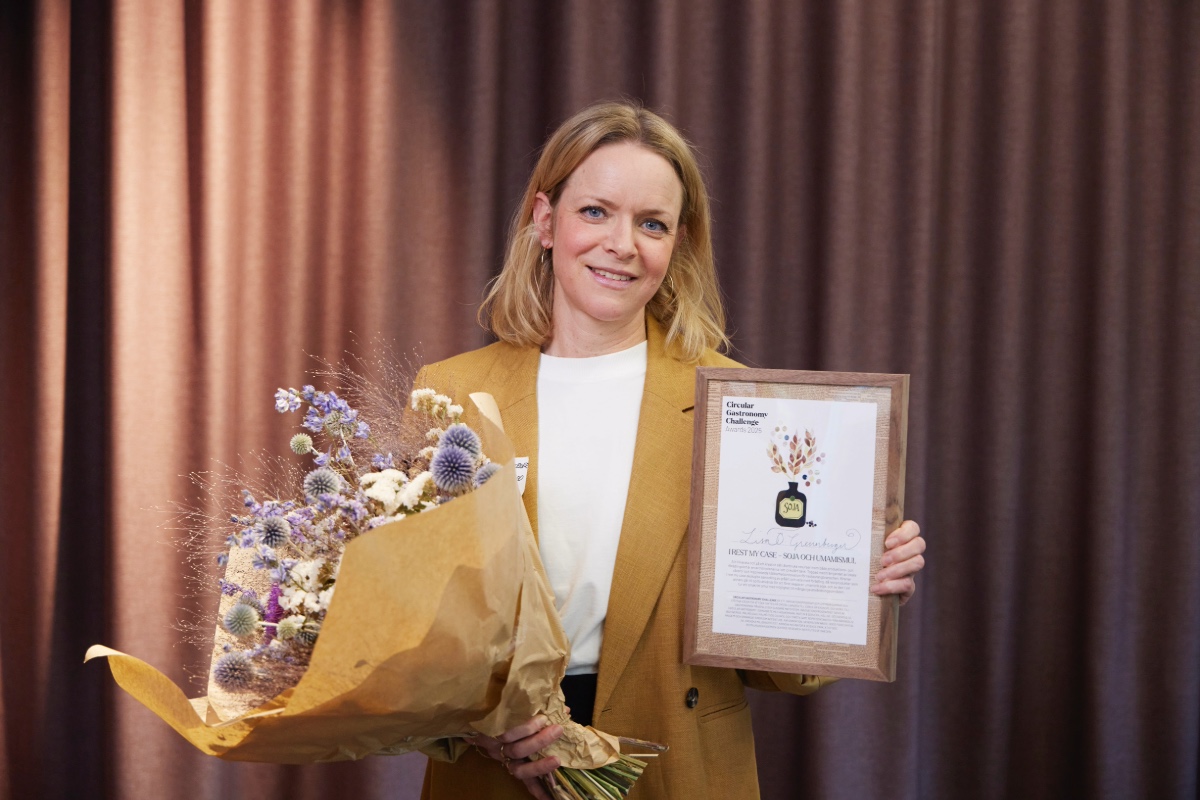
“What could you do with this?” With a soy sauce made from by-products from her own farm, Lisa Grennberger hopes to inspire others to ask themselves that same question.
Text: Ebba Svennung. Foto: Erik Olsson
The grey pea, much like the sweet pea, needs something to climb on as it grows, otherwise it simply lies down flat. At Stillinge farm in Östergötland, it is wheat stalks that serve as the support structure. The peas and wheat are then harvested in a single sweep before being separated and cleaned in the next step. What remains – the chaff – has traditionally been discarded. But not anymore! That is precisely what this idea is about: making something worthwhile out of what is left over – in this case, many kilos of chaff.
“For me and my family, it is important to be part of the change to the food system that is necessary. That requires creative thinking. We wanted to work with the whole raw ingredient and make sure nothing goes to waste,” says Lisa Grennberger.
The fact that soy is normally a fairly climate-unfriendly product is another important aspect.
“Soybeans are mostly imported from South America and East Asia, and the soy itself often has colourings and enzymes added rather than being naturally fermented. On top of that, the imported beans are usually conventionally grown – unlike our grey pea, which is an old heritage variety, and both locally grown and organic.”
Lisa Grennberger grew up on the farm, which has been in her family for five generations. Her parents, who converted to organic farming in 2000, are still involved and help out, and Lisa’s brother Linus now runs the agricultural side. In the small village of Gammalkil, a few dozen kilometres south of Linköping, there is also a cheesemaker and a flatbread baker. They collaborate where they can and encourage one another – fertile ground for innovation.
And so it was that Grennberger and a few chefs experimented with the chaff and developed a soy sauce – which yielded yet another by-product: a dry crumble that could potentially be used as a seasoning in both savoury and sweet cooking.
It is clear that the opportunity to inspire others to think “zero waste” is just as important to Grennberger as creatively using the by-products from her own farm. The more people think along those lines and collaborate across professional boundaries and with different areas of expertise, the greater the difference that can be made to the enormous quantities of potential food that are thrown away today – and should instead be seen as a resource.
Since Stillinge already delivers grey peas, yellow peas and bread wheat directly to restaurants, the restaurant world is seen as a natural route for getting the new soy products out there and introducing them to an audience. Soy is, after all, already well known in the market. Grennberger believes there is every opportunity to take their soy into public sector kitchens as well. And this coming spring, a trial batch will be produced for a further group of chefs to test and work with.
The name – I Rest My Case? It came about just as the application for the Circular Gastronomy Challenge was being submitted.
“It just popped into my head. Rest as in remainder. And it’s what you say in legal contexts, and nowadays in all kinds of situations: ‘I have nothing to add.’ As if the product speaks for itself.”
When Circular Gastronomy announced the winners of the Circular Gastronomy Challenge 2025 on 26 January, Lisa Ö Grennberger was one of them. The jury’s citation read as follows:
“Making use of resources in a creative way and repurposing them within both production and processing is one of the cornerstones of circular thinking. Promoting local ingredients and inspiring sustainability innovation for the restaurant industry, I Rest My Case combines the organic co-cultivation of grey peas and wheat with processing – using by-products that would otherwise go to waste to create an umami-rich soy sauce, and from that a flavourful crumble with potential for many new applications.”
Now that you’ve won the Circular Gastronomy Challenge, what kind of support are you hoping for?
“To find partners with the right expertise who want to come along on the journey. Different people who want to move things forward with us – you don’t have all the knowledge about everything yourself. It’s through contact with and help from others that you find new paths; that’s how ideas are born. We would need help with business development and product development… We would also need a production space where we can experiment. It will be exciting to get the dialogue and collaboration with Circular Gastronomy started and see where it takes us.”