

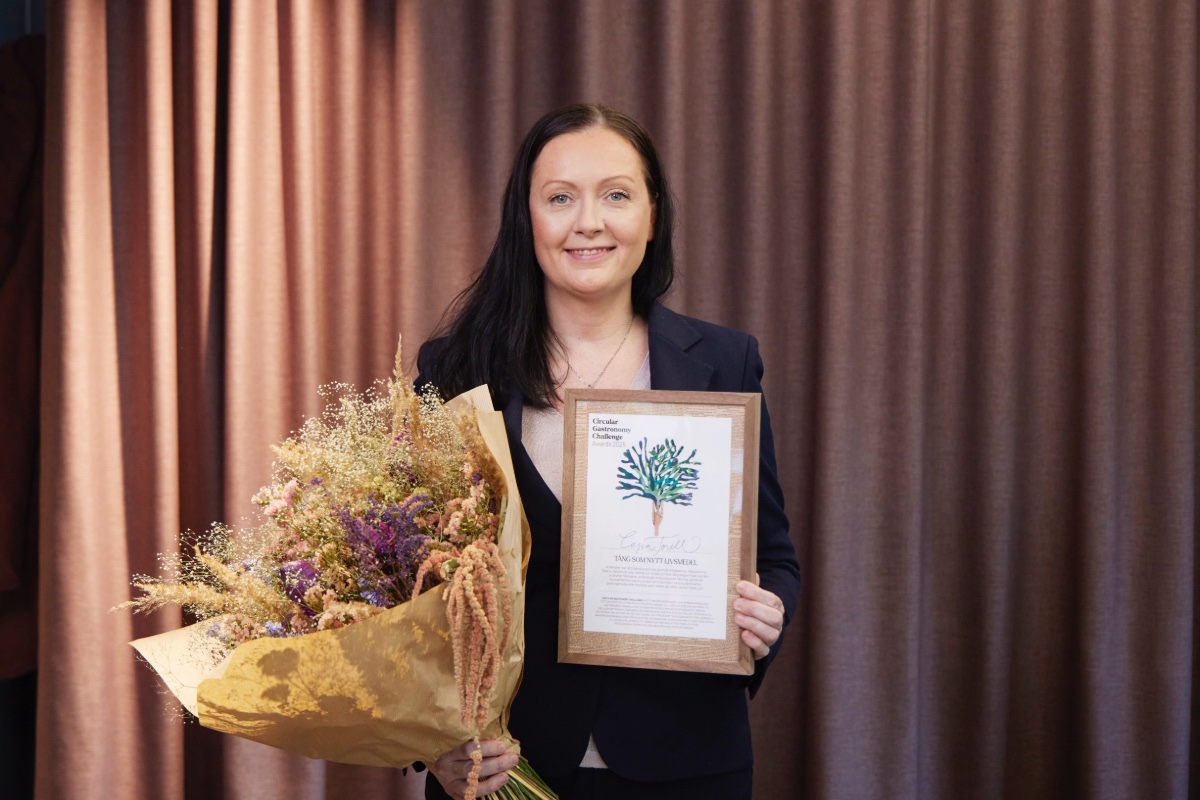
There are many benefits to seaweed, both for life in the sea and on land. Now it’s simply a matter of embracing seaweed gastronomically. Cajsa Torell and her colleagues have figured out how.
Text: Ebba Svennung. Photo: Erik Olsson
We hear more and more these days about seaweed farming, about how much good seaweed does by cleaning the oceans and absorbing carbon dioxide, and how healthy it is for us humans too. The question is simply how to get more people eating it. Kobb’s idea is to develop products that make it easier for us to make seaweed part of our food culture.
“Few people know how to use seaweed in the kitchen, and it hasn’t been easy to get hold of either. Creative chefs enjoy experimenting, but for a long time the only seaweed available on the market has been Asian varieties,” says Cajsa Torell, who was eager to work with a locally grown ingredient.
Kobb originally cultivated seaweed on a small scale. Torell was involved when the company split into two – one focused on seaweed farming, now trading under the name Swedish Kelp, and Kobb, which is now a dedicated food company processing raw seaweed into ready-to-eat products.
Food production got underway in 2023 in Glommen, outside Falkenberg on Sweden’s west coast. The production, in which farmed seaweed is the primary ingredient, generates returns for seaweed farmers’ harvests and results in entirely new products for restaurants and consumers. A seaweed salad with soy and chilli became Kobb’s first product to market.
“We approached the restaurant industry with it – that felt like a natural place to start,” says Torell. “Partly because it’s a good arena for people to encounter new flavours, and we began with Asian restaurants where the flavour profile of seaweed is already familiar.”
Through Sushi Yama, with around fifty restaurants across Sweden, the seaweed salad achieved wide distribution as a side dish – and was well received. Kobb’s range now includes several flavour variations, among them a pickled version used in fish and chips as an alternative to pickled red onion. Before long the seaweed salads will also become available for public catering. The City of Gothenburg is among those who have expressed interest in serving them in schools.
Kobb’s seaweed salads are also being launched in a number of retail stores for consumers in the coming days. The company has chosen to enlist a well-known chef. Frida Ronge, whose portrait adorns the packaging, is also a co-owner of Kobb and the person behind the flavours of the seaweed salads, of which there are now five.
“Since the ingredient is new to many people, it’s of course hugely important that our products taste good,” says Torell. “With Frida Ronge on the team we ensure a flavour that surprises many people – in a very good way. We will also be running in-store product demonstrations where people can taste and get tips on what to pair the salads with; once you’re home it’s simply a matter of thawing and serving.”
Sugar kelp is the main seaweed they use. It is harvested in April and most of it is frozen as-is, to be thawed, processed and refined later. The seaweed is blanched for the sake of texture and colour, then the remaining ingredients, dressings and seasonings are added. Sugar kelp is rich in iodine, which is beneficial for us in the right amounts, and the blanching helps reduce it to a suitable level.
“One of our strengths lies in having found the right technique for processing seaweed into a finished product that is pleasant to eat,” says Torell. “In its natural state, seaweed is tough, strong and difficult to handle. The technique is scalable and the goal is to increase production volume going forward, which contributes to greater returns and larger cultivated volumes for seaweed farmers. The more that’s cultivated, the better!”
Kobb’s seaweed is sourced from seaweed farmers in Sweden and also Norway, which has equally clean waters. Other species besides sugar kelp may become candidates for processing in the future, and Kobb is working on developing seaweed products across more food sectors.
Cajsa Torell was one the winners of the Circular Gastronomy Challenge 2025, announced on 26 January. The jury’s citation read as follows:
“We need more readily accessible, great-tasting food made from environmentally positive, healthy ingredients. By processing Nordic seaweed, Kobb does exactly that – creating products ready to use in restaurants or at home, made from resource-efficient marine crops that require neither fresh water, fertiliser nor land, but instead benefit both us and the sea.”
Now that you’ve won the Circular Gastronomy Challenge, what type of support are you hoping for?
“The technology and products are already in place. We are primarily looking for help with communication – not just around awareness of how much good seaweed does for the ocean and for those of us who eat it, but also about how good seaweed can taste. Since it is a relatively new food in our culture, we need help getting the message out. When products made from farmed seaweed start being consumed on a larger scale, it encourages further cultivation. With that, we could strengthen sustainability on several levels.”